Description
The Lobuche East Peak Climbing expedition is one of the most popular and rewarding high-altitude mountaineering objectives in the Everest Region, combining the legendary Everest Base Camp trail with a serious and technically engaging summit climb to 6,119 metres. It is an ideal expedition for experienced trekkers making their first step into technical Himalayan mountaineering.
The journey begins with a scenic flight to Lukla and follows the classic Khumbu trail through Namche Bazaar, Tengboche, and Dingboche before turning toward the Lobuche valley. The approach to High Camp passes alongside the Khumbu Glacier moraine, with the towering presence of Lobuche East growing more imposing with every step. A visit to Everest Base Camp is included in the itinerary, adding an iconic landmark to an already exceptional journey.
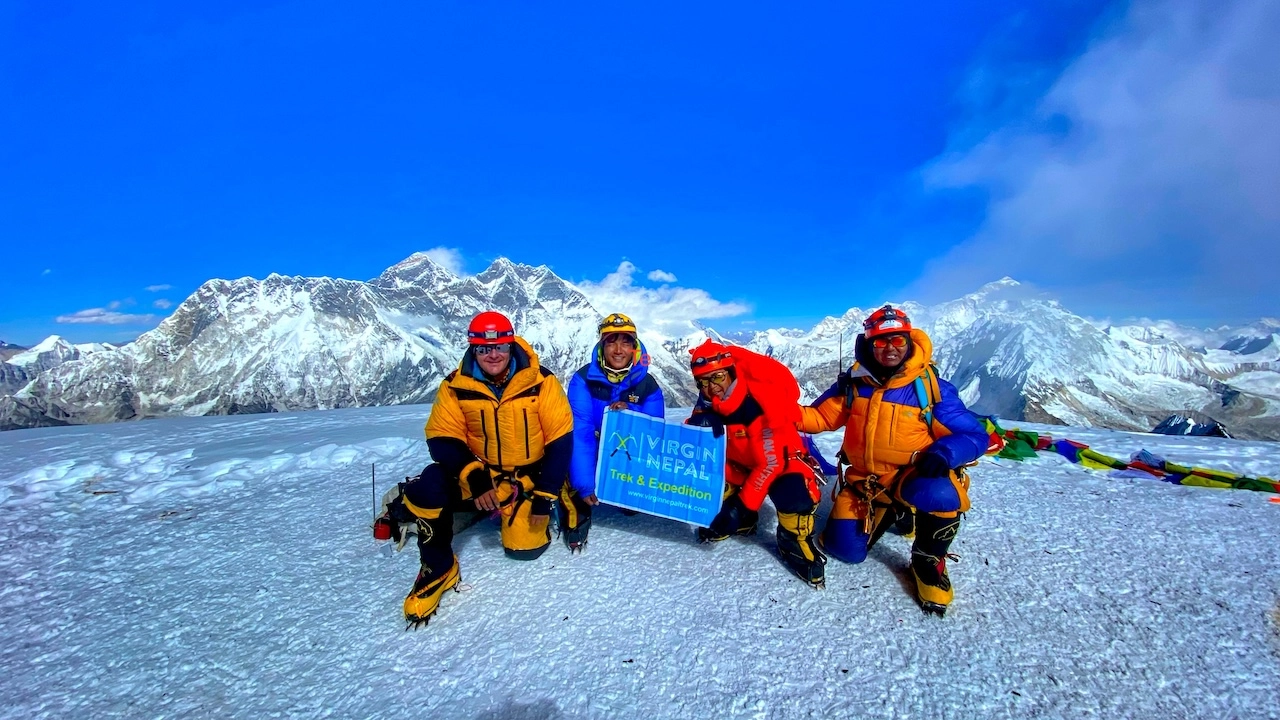
The technical section of the climb involves steep snow and ice slopes, fixed rope sections, and a demanding final ridge to the summit. The views from the top — spanning Everest, Lhotse, Makalu, Cho Oyu, Nuptse, and the full sweep of the Khumbu — are among the most spectacular rewards available on any 6,000m peak in Nepal.
With Virgin Nepal Treks and Expeditions, you are guided by an experienced Sherpa climbing team with deep knowledge of Lobuche East, ensuring thorough preparation, strong technical support, and a safe and well-managed summit experience.
Culture of the Everest Region
The approach to Lobuche passes through the heartland of Sherpa culture in the Khumbu valley. Monasteries, mani walls, and chorten-lined trails reflect a living Buddhist tradition that has shaped this mountain community for centuries. The spiritual atmosphere of Tengboche Monastery and the warmth of Sherpa teahouse hospitality along the route add a deeply human and culturally rich dimension to what is already an extraordinary mountaineering journey.
Best Season
Spring (March to May): Stable weather, well-established routes, and moderate temperatures make spring the most reliable and popular season for Lobuche East.
Autumn (September to November): Crisp, clear conditions and excellent mountain visibility offer a strong alternative season for this climb.
Contact our team for pricing, preparation guidance, and a custom climbing plan for Lobuche East.
Day By Day Itinerary
Welcome to Himalayan country of Nepal. Upon your arrival at the Tribhuvan intl. airport our representative welcomes you and assists to transfer in your hotel in Kathmandu. After time to get refreshed, evening you'll meet and transfer for welcome dinner.
After breakfast, we will meet to check your clothing and trekking equipment (sleeping bag, down jacket and trekking boots). This evening will be spent in Kathmandu.
We drive to airport early in the morning to take our flight to Lukla. The scenic 35 minutes flight to Lukla caters the panorama of the peaks of Langtang, Rolwaling and Annapurna Himalayan Ranges. Landing at Tenzing Hillary Airport in Lukla . Instantly, after making the final arrangement for the Mera Peak Climbing , we kick off.
A good trail leads through pasture to the edge of a diminishing forest of rhododendron and pine which clothes the steep hillsides above Lukla. We make steady progress on a good trail, crossing ridges and streams up to ‘kharka’ used for grazing yaks where we’ll stop for overnight tented camp.
Walking through a beautiful pine forest, the track leads us along the Dudh Koshi River through many suspension bridges, one of which is the famous Hillary Suspension Bridge. First, we catch wonderful prospect of the glistening Mt. Thamserku (6618 m). Through the settlement of Benkar, Chumoa, Monjo, we come to the check post and entrance to Everest National Park. We pass through the last village of Jorsale before reaching Namche Bazaar.
The trail climbs through the forests and bridges until we reach the confluence of the Dudh Koshi and Bhote Koshi rivers. After a final steep ascent of about two hours we get first sight of Mt. Everest peering over the Lhotse-Nuptse ridge. Upon this juncture, we stop at Chautara to admire the view. We still need to hike about 1.5 hours to reach Namche Bazaar, a gateway to Mt. Everest and main trading centre of this region. We stay overnight in Namche Bazaar.
This is the first of the two days set aside for "acclimatization". Health experts recommend us to stay active and moving during the rest day too instead of being idle. We either spend the day taking a day's hike to Thame or visiting Khunde or relaxing and exploring Namche Bazaar itself. Namche Bazzar is the main centre of the Everest (Khumbu) region and has government offices, ATMs, Internet cafes, shops, restaurants, a bakery and a colourful market each Friday evening and Saturday.
If we trek a few hundred vertical feet during the day, it will help us to properly acclimatize. Our guides take us to the Tourist Visitor Centre near the headquarter of the Sagarmatha National Park where we can observe an assortment of things related to the first Everest ascenders, Sherpa culture and learn about the various plant and animal life of the Everest region.
Upon breakfast in Namche, we set out towards Tengboche, enjoying superb view of Mt. Everest, Mt. Nuptse, Mt. Lhotse, Mt. Ama Dablam and close up view of Thamserku. Our trek follows more or less smooth trail with few ups and downs which will not bother us as the magnificent view of the Himalayas keeps our company all through the journey. Along the way, we can spot wildlife musk deer, a herd of Himalayan Thar and multicolored pheasants. The trail goes gradually down up to Kayangjuma.
The path eventually reaches Sansa, which is the major trail junction to Gokyo valley and Everest Base Camp. The track then follows through the pine forests and after we cross the prayer flags festooned bridge over the Dudh Koshi River, we reach Phunki Thenga, a small settlement with a couple of teahouses and a small army post amidst the alpine woods.
After having a relaxed lunch at Phunki Thenga, we gear up for a slightly tougher climb through the pine forests before we reach Tengboche. Tengboche is a great place for close up views of Mt Ama Dablam, Mt Nuptse, and Mt Everest, and it has the biggest Buddhist Monastery of the Khumbu region. We pay our visit to the monastery the same day at around 3 pm to witness the ceremony in the principal and popular monastery of Everest region. Overnight stay at Tengboche.
With mountains at its backdrop, the monastery at Tengboche looks more spectacular in the morning. At this juncture, we can take pictures of the monastery and the scenery around and as usual start the day journey. We choose the upper trail for better views on the way to Pangboche village. We pass through several Chortens and Mani walls and small villages.
The place where we stop for lunch not only serves delicious food but also allows a fantastic close-up view of Mt Ama Dablam. In the afternoon, we walk north to Pheriche or take the eastward trail beneath the towering north face of Mt Ama Dablam. From here onwards, the walk is fairly moderate as we enter the Imja Valley.
The valley gradually unfolds as we approach the confluence of the Lobuche River. We descend into the river and begin the last and steepest climb of the day up to Dingboche. On arrival at Dingboche, we will see beautiful array of fields enclosed by stone walls to protect barley, buckwheat and potatoes from the cold winds and grazing animals. Overnight at Dingboche.
We spend our second day of acclimatization at Dingboche. A refreshing breakfast while admiring a looming Ama Dablam (6856m/ 22493 ft) to the south is really fantastic. To better appreciate Mt Ama Dablam, Mt Lhotse and numerous other peaks visible from Dingboche, we climb the ridge on the north behind the village.
This will be an ideal acclimatizing excursion. Upon this juncture, we can see three of the world's six highest peaks, Mt Lhotse, Mt Makalu and Mt Cho Yu. To the west, loom the towering peaks of Cholatse (6440 m/21,126 ft) and Taboche (6542 m/ 21,463 ft). As we look northwest, we see an array of peaks rising at the head of the Khumbu Khola Valley.
The Lobuche West and Lobuche East peaks are most dominant along with Lhotse which stands over 8500 meters (8501m/27, 890 ft). From a vantage point high on the ridge, we can scan the sweeping Imja Khola valley as well as the picturesque fields and pastures of Dingboche. Overnight at Dingboche.
We start the day with a climb to Duglha through the Khumbu Khola valley. The walk along the arid terrace is rewarding with awesome views of mountains on all sides. As we come to a yak herder's place called Dusa, the valley begins to narrow and we continue through Phulung Karpo, the camp site of the first successful Everest Expedition in 1953. Above Phulung Karpo is Chola Lake. As we move on, the majestic view of Mt. Pumori (7138 m/ 23418 ft) comes into view. As the trail descends and curves, Mt. Pumori disappears from view and we come across a roaring stream. After crossing a small wooden bridge, we ascend to Duglha.
We can see the tip of Mt Nuptse from here as well as Mt Cholatse, Mt Thamserku, and several other magnificent peaks. We climb up the steep terminal moraine of the Khumbu Glacier. We pass through boulder-strewn slopes as we ascend Chupki Lhara, an eerie ridge top with dramatic mountain views. At the top of the ridge, we will find an array of stones with prayer flags used as memorials to Scott Fischer (American mountaineer) and 10 times Everest submitter Babu Chiri Sherpa (a Nepali mountain guide) who perished on a mission to climb Everest. As the trail drops to the Khumbu Glacier moraine, we find ourselves facing several great peaks - Khumbutse, Lingtren, Pumori and Mahalangur Himal.
We are now in the vicinity of Everest but the great mountain still remains elusive. Mt Nuptse towers to the right as the trail crosses the Khumbu Glacier. As we pass along a murmuring stream leaving the Khumbu Glacier behind, we now begin to feel a little out of breath due to high altitude. Overnight at Lobuche.
The trail to Gorak Shep goes ahead through the lateral moraine of the Khumbu Glacier. We pass through the pyramid sign post. Ahead on the trail we see crest of north ridge of Everest along with Mt. Pumori, Mt. Mahalangur, Mt. Lingtern, Mt. Khumbutse, Mt. Nuptse, etc. A small ascent would take us to Thangma Riju from where we perceive 360 degree vista of snowy mountains.
Climbing steeply up to the top through the torrent of Changri Glacier, we catch our first glimpse of Kala Patthar, a grey-green knoll beneath the Mt. Pumori is we reach Gorak Shep, we will find snow-capped mountains looming all around us including the top of the world - Mt. Everest. After a brief lunch and rest, we take the trail to Everest Base Camp through the once vast Gorak Shep Lake. Continuing straight ahead, we come through the Indian army mountaineers' memorials.
Only upon reaching the Everest Base Camp do we really appreciate the Everest climbers who brave the hazardous route through the Khumbu icefall. Mountaineer's tents stand out in bright colours against the monotony of gray surroundings (especially in the Spring). Nuptse, Khumbuste and Pumori are the mountains we can view from the base camp. Everest actually is not visible from here. By now we have met the ultimate objective of our trip. However, the sunset view from Kala Patthar is more admirable than the sunrise view, so it is suggested to visit Kala Patthar today during sunset.
As the setting sun's rays strike the snow capped mountains the resulting scenery is indescribable. For those trekkers who wish to continue to Kala Patthar, our guides and Sherpa coordinate in hiking to Kala Patthar for amazing sunset view today rather than waiting until the next day. Overnight in Gorak Shep at a local lodge.
We prepare for an early morning departure, amid pre-dawn darkness and cold temperatures (-10 to -14 C). Plus, there is always the potential for chilly winds which are quite common. Familiar peaks such as Lingtren, Khumbutse, and Changtse tower to the east even as Everest begins to reveal itself. But, it is upon reaching Kala Patthar that we get to see 360-degree up-close and formidable views of Mt. Everest. We take pictures, enjoy the magnificent mountain panorama, and then return back to Lobuche for a good night's rest. Overnight in Lobuche.
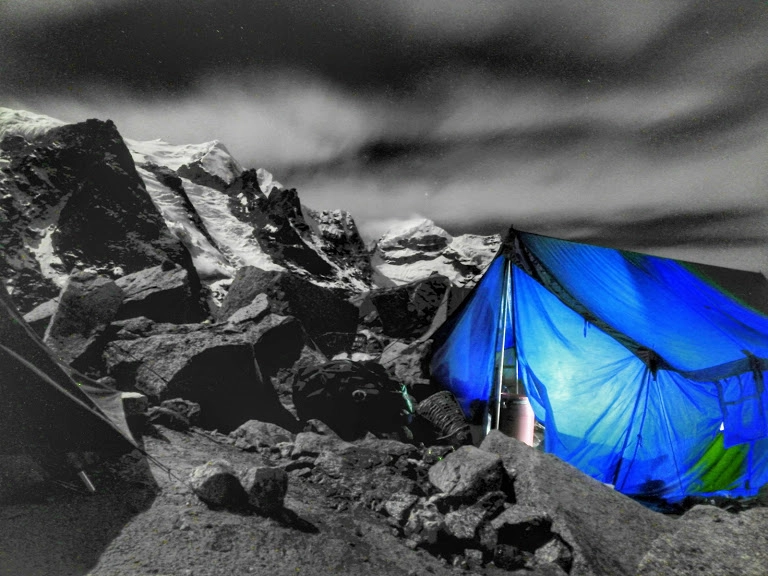
From Lobuche, we trek towards Lobuche base camp. After walking some distance on a relatively flatter plain, the path to the Lobuche Base Camp gets steeper and rocky. We move forward along the Lobuche Glacier while enjoying great views of Ama Dablam, Cholatse, Pokalde, Thamserku, Kantega and other Himalayas. From the base camp, we continue on a rocky moraine path to reach the High Camp. After reaching there, we set up our camp, take lunch and will have rest. For the climb, we usually will be climbing on rocky surfaces for up to around 5770m.
After that, we climb on ice and use ropes when necessary. However, the use of the rope and the length depends upon the season and the crevasses. Fixed rope is used most of the time whereas man rope is used when required. The climbing leaders will decide what is best for when. Overnight in Lobuche East High Camp. Pre-Climb Training: Our guides will provide training on peak climbing techniques and the proper ways of using climbing gears such as the ice axe, climbing boots and crampons, harness, ascender, etc. The training will also include using ropes to go up and down.
We strongly believe that the training experience will boost your confidence and climbing skills to increase the chances of scaling the summit as well as to fully enjoy the experience.
We wake up early today at around 12 to 1 am and have our breakfast before beginning our climb. It is important we reach the summit before noon because in the afternoon the strong winds in the high lands might become a barrier for a successful summit. We will most likely be walking on rocky surfaces up to around 5700m after which we climb on ice. We use both fixed rope and man rope as per our leader’s instruction.
The climbing surface as well as the length of the rope depends on the time of the season and the crevasses. Lobuche East offers more panoramic views of the mountains than any other trekking peak. From the summit, you get to enjoy magnificent views of Everest, Lhotse, Nuptse, Ama Dablam, Cholatse, Pumori, and many more. We spend some time at the summit celebrating and taking pictures, then we get back to the High Camp again for an overnight stay.
This is an extra day set aside to manage any unintended hindrances like flight delays or bad weather for climbing. Setting aside an extra day will ensure that even if we were to face a day's set back, the trip will continue thus guaranteeing a successful climb.
After taking our morning breakfast, we trek downhill from Lobuche High Camp and join the Everest Base Camp route at Lobuche again. We will take our lunch at Lobuche. From Lobuche we again retrace our path to Pheriche. On the way to Pheriche, we get to enjoy magnificent views of Mt. Ama Dablam in the distance. From Pheriche, we continue to Pangboche.
We trek down through the hillside blanketed by rhododendron and juniper trees. If it's spring, pink and red rhododendron flowers ablaze our surroundings. Upon reaching Pangboche we may also consider visiting the famous Pangboche Monastery.
From Pangboche, we retrace our steps down to the Imja Khola and up through the forest to Tengboche. If interested, we can also visit nuns at the Tengboche monastery. After lunch at Tengboche, we continue through the hillside blanketed by rhododendron and juniper trees. After crossing the bridge over the Dudh Koshi River, our trail follows the Dudh Koshi gorge descending rapidly through the pine forests before reaching Sansa.
We keep a lookout for wildlife such as mountain goats, snow leopards, colorful pheasants, etc., while passing through the forest. After passing a chorten, we go to the army camp at Namche Bazaar. Overnight in Namche Bazaar.
We descend on a rocky trail and cross several suspension bridges before walking on a levelled trail. The air is warmer as we walk on the same trail to reach Lukla. Our trek in the mountain ends after we reach Lukla. We spend our time reminiscing about our time spent in the mountain.
We fly back to Manthali after our long mountain journey. We fly early morning flight to Manthali as possible as ,drive to Kathmandu. We can rest and relax throughout the day at hotel. If we get interested to take some gifts home from Nepal for friends and relatives, we can visit to some nearby shops or venture out at Thamel for typical Nepalese goods.
This short excursion either can be assisted by trekking guides or we can do it ourselves too. If we want to explore any other areas in Kathmandu, we have managed time for this today as well! At the evening we will be at a fantastic celebration dinner together for successfully completing our trek to Everest Base Camp hosted by Virgin Nepal Trek and Expedition! Overnight at Kathmandu.
Our journey in Nepal comes to an end today! A VNTE representative will drop us off at the airport approximately 3 hours before our scheduled flight. On our way to home, we have plenty of time to plan our next adventure in the wonderful country of Nepal.
Inclusion and Exclusion
-
Airport pickup and drop-off in Kathmandu
-
Hotel accommodation with breakfast in Kathmandu
-
Domestic flights (Kathmandu – Lukla – Kathmandu)
-
All ground transportation as per itinerary
-
Sagarmatha National Park permits and peak climbing permit
-
Experienced trekking guide and climbing Sherpa team
-
Teahouse accommodation during trekking phase
-
Tent accommodation at high camp
-
Meals during trekking and climbing period
-
Group climbing equipment (ropes, anchors, fixed lines)
-
Basic climbing training before summit attempt
-
Medical kit and emergency support
-
Staff insurance and expedition logistics
-
International airfare
-
Nepal visa fees
-
Personal climbing gear
-
Travel insurance (mandatory)
-
Personal expenses (drinks, WiFi, snacks)
-
Tips for guides and porters
-
Rescue and evacuation costs
Gear List & Preparation Notes
Clothing: High altitude down jacket, base layers, insulated mid-layer, waterproof shell jacket and pants, climbing gloves and liners, warm hat, sun cap, thermal socks
Footwear: Double mountaineering boots, trekking shoes, camp shoes, gaiters
Climbing Equipment: Harness, crampons, ice axe, helmet, ascender, descender, carabiners, headlamp with spare batteries
Personal Items: UV sunglasses, sunscreen, lip balm, water bottles, sleeping bag (-15°C), trekking poles, personal medication, toiletries
Physical: Begin training at least 3 to 4 months before departure. Focus on cardiovascular endurance, stair climbing, and long hikes with a loaded pack to build the stamina required for sustained high-altitude effort.
Technical: Prior experience with crampons, ice axe, and fixed rope techniques is essential. A mountaineering skills course before departure is strongly recommended for first-time technical climbers.
Altitude: The climb reaches 6,119 m. The acclimatisation days built into the itinerary are essential — follow the schedule carefully and never push through warning signs of altitude sickness.
Mental: Summit day on Lobuche East is long, cold, and demanding. Strong focus, trust in your guide, and a calm and methodical approach will make the decisive difference.
Insurance: Choose a policy that covers technical high-altitude climbing and helicopter evacuation at expedition altitudes.
Gear: All technical equipment must be tested and familiar before departure. Practice crampon and ice axe techniques during training if you are new to alpine climbing.
Talk To Expert
CEO/Founder